Why AI Is Different: Every Prior Tool Took Sides
Why AI Is Different: Every Prior Tool Took Sides
In the latest episode of For All Mankind, a young Helios employee named Alex Baldwin — Ed Baldwin’s grandson — finds a folder marked “Automation” on a server he isn’t supposed to access. He sneaks back into the office at night and cracks it open. Inside is a joint plan between Helios and its Russian partners to automate 98% of the labor on Mars. Every human worker would be sent back to Earth. The base would keep producing. The Martians would not.
Alex leaks the documents.
You can read his choice as just another riff on tech-displaces-workers, but I think it’s pointing at something more specific. The colonists’ real objection isn’t “automation is evil.” It’s “you decided this without us.” That distinction matters, because every wave of automation in human history has been fought on the same line.
The Pattern of Every Automation Wave
The Luddites in 1811 were skilled machine operators, not anti-technology. They smashed wide knitting frames because mill owners were using them to cut wages and hire unskilled labor — to circumvent the deal, not to make better cloth. Britain put them down with 12,000 troops, more than Wellington took into Portugal. The machines won. The men did not.
Malcom McLean’s shipping container, in 1956, dropped the cost of loading a ton of cargo from $5.86 to 16 cents. The Port of New York went from 30,000 longshoremen in 1970 to 7,400 by 1986. The cheap, globally-sourced life we all live now sits on top of those 22,600 jobs.
Every time, the same shape: the technology arrives, the workers resist, the leaders win, the world is materially richer a generation later, and the specific people who lost their jobs rarely recover. Their kids enter the new economy. They don’t.
So when people raise the same alarm about AI, they’re not being unreasonable. They’re being historically literate.
What’s Different This Time
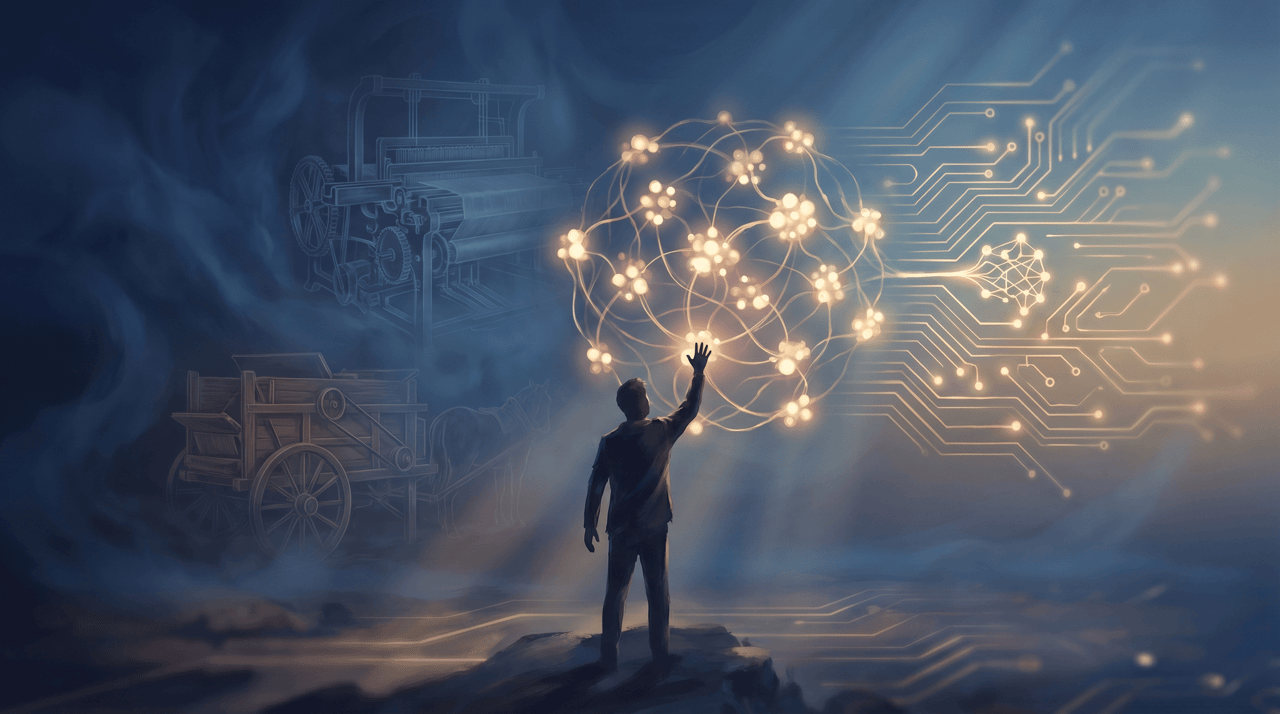
But I think AI is different — not because the fear is wrong, but because the thing being automated is itself the lever people have always used to escape their situations.
Every prior automation wave deployed a capacity. Looms wove. Threshers threshed. Containers stacked. To benefit, you had to own the machine, work the machine, or sell to the machine’s owner. The tool didn’t help you understand your world or argue your case. It just made some narrow output cheaper.
AI deploys intelligence itself. That is a categorically different kind of tool — and it’s the same shift I’ve been writing about from the inside, where the bubble of what you can get done is effectively infinite. A farmer in rural Kenya with a phone can ask a model to explain why her crop yields dropped, draft a letter to her cooperative, walk her through the legal process for a land claim, tutor her kids in math. None of that required a model that “takes” anyone’s job. It just required her to ask. The same instrument that threatens knowledge workers in San Francisco can lift a smallholder in Nairobi out of dependence on whatever local authority used to gate her access to information.
Look at what social media did. In a decade it pulled marginalized voices into global view, gave Arab Spring protesters a coordination layer, broke state monopolies on what news got reported. It also fed echo chambers, replaced face-to-face community with parasocial scrolling, and built the most efficient outrage machines in history. Both halves of that are real. Neither cancels the other.
AI will be the same shape, only with more leverage. The risk is intellectual atrophy and a deeper turn inward — outsourcing not just our friendships but our thinking. The opportunity is that, for the first time in history, the things the powerful have always hoarded — expert knowledge, legal knowledge, medical knowledge, the ability to draft and argue and translate — are available to anyone with a question and a network connection.
The Luddites had no such option. Neither did the longshoremen. They could resist the machine or accept it; they could not turn it around and use it on their own behalf.
Alex Baldwin leaks the Helios documents because that is the only form of agency a worker has when he’s been excluded from the decision. AI changes that math. The next Alex doesn’t have to wait for the leak — he can ask the question himself.
Living It
I’ve been trying to live that. My work has shifted in the last year toward orchestrating AI rather than competing with it — driving CI/CD pipelines that handle the rote of building and shipping software, so my hours on the job go toward decisions, design, and the things only I can do. The point isn’t to do more work. It’s to deliver more value in the same hours. That’s a reframe the historical worker never got to make, because the threshing machine didn’t come with a steering wheel for the man it replaced. AI does. Leaning in — choosing to learn and listen rather than hold the line on what I already knew — is, I think, the most rational response a worker has ever had to a wave of automation.
So can I.
Related Reading
- It’s Not What You Can Do — It’s What You Can Get Done — The infinite bubble: what changes when intelligence itself becomes the tool
- The Cost of Every Yes — The strategic frame for what to do with the new leverage
- Innovation Breaks Things. Culture Eats Strategy. And “Lean In” Has Lost Me. — Why “lean in” only works when the environment is safe to lean into
- The Paradoxical Art of Doing and Not Doing — The other risk: AI capability without the discipline of restraint

About the Author
Kevin P. Davison has over 20 years of experience building websites and figuring out how to make large-scale web projects actually work. He writes about technology, AI, leadership lessons learned the hard way, and whatever else catches his attention—travel stories, weekend adventures in the Pacific Northwest like snorkeling in Puget Sound, or the occasional rabbit hole he couldn't resist.