Innovation Breaks Things. Culture Eats Strategy. And 'Lean In' Has Lost Me.
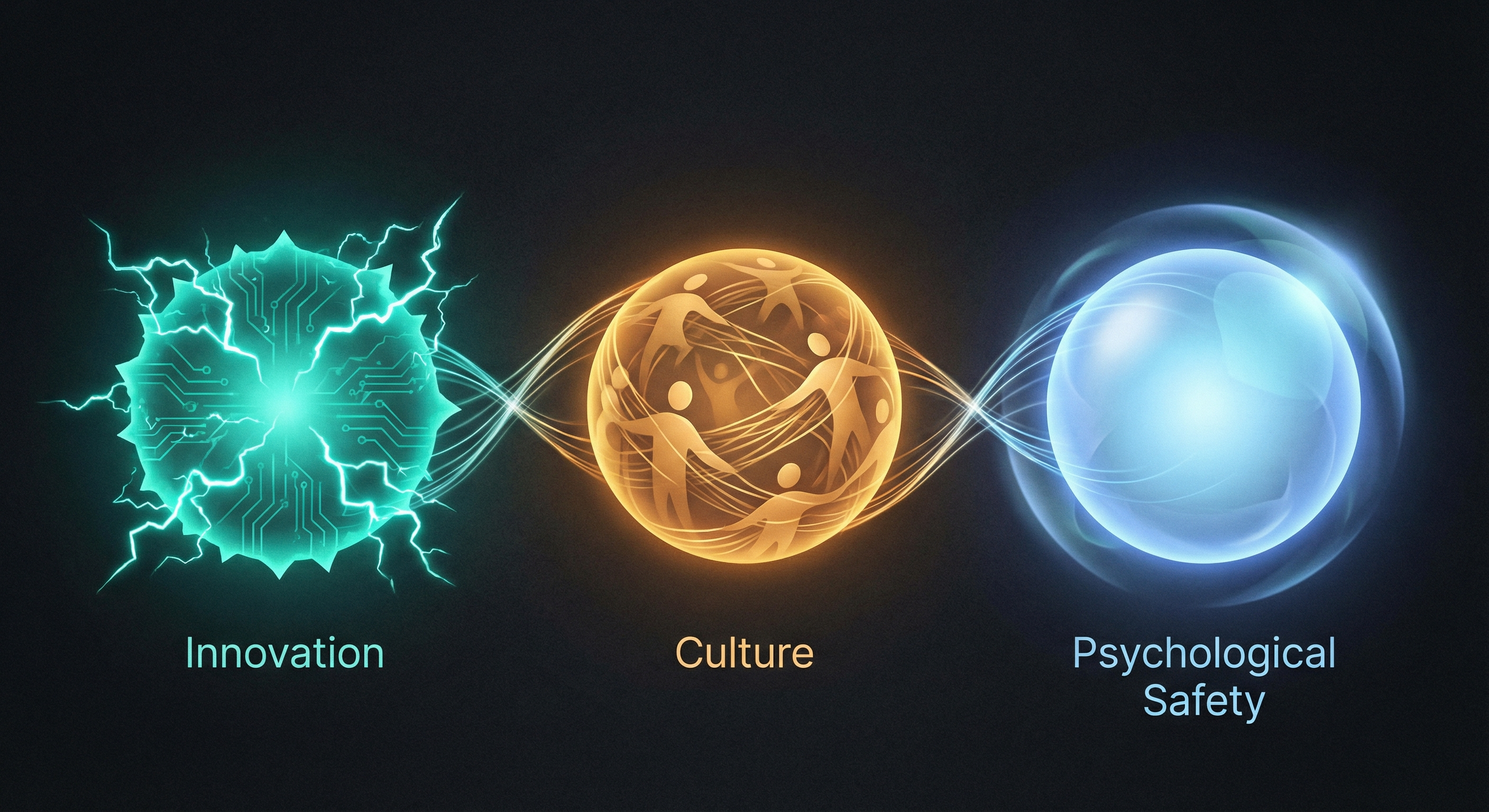
Innovation Breaks Things. Culture Eats Strategy. And “Lean In” Has Lost Me.
Three ideas I keep coming back to. They’re connected, though I’m still working out exactly how.
On Innovation
The word itself is clarifying if you take it literally: to innovate is to introduce new methods, ideas, or products into something established. That’s the key phrase — into something established. Which means standard work breaks. Processes that existed before the new idea don’t cleanly accommodate it. “The way we’ve always done it” changes, and in changing, it resists.
Things break when you cause change. That’s not failure — that’s the friction of innovation doing exactly what it’s supposed to do. The cost of introducing something new into an established system is that the system pushes back. Buttons get harder to push. Seams show. People who built the old system feel the displacement.
This makes innovation a vulnerable process. You’re asking people to break things they built, abandon habits they’ve honed, and absorb the awkwardness of not-yet-working while something new finds its footing. That’s a real ask. And it’s fundamentally incompatible with a culture that punishes friction.
Asking people to innovate while treating every stumble as a problem to be managed is a contradiction. The friction isn’t incidental to the innovation — it is the innovation, in its early form. The question worth asking isn’t whether things are breaking. It’s whether leadership is building the support structures — the psychological safety, the permission to fail, the time to iterate — that make breaking things survivable.
How is leadership actually supporting us to innovate today? Not in theory. In practice.
On Culture
Seth Godin’s framing cuts through a lot of noise: “Culture is ‘people like us do things like this.’” Simple, almost too simple — until you sit with it. Culture isn’t a statement in a slide deck. It’s the behavioral baseline. What do people around here actually do when no one is watching? What gets rewarded in the room and what gets quietly penalized? That is the culture, whatever the values poster says.
Drucker’s line about culture eating strategy for breakfast is often quoted and rarely absorbed. The implication isn’t just that culture matters — it’s that culture is the substrate. Strategy is built on top of it. When strategy conflicts with culture, culture wins, slowly and invisibly. Initiatives fail. Rollouts don’t stick. People nod in meetings and then go back to doing what they’ve always done, not because they’re resistant, but because the culture hasn’t moved.
This is why culture activation matters more than any single initiative or program. You can’t overlay a new strategy on an unchanged culture and expect durable results. You have to work on both simultaneously, which is slower and harder than announcing a pivot.
The harder question for a global organization: how does a distributed team — across geographies, languages, functions, and time zones — actually align on shared culture? Not shared vocabulary. Shared behavior.
On “Lean In”
This phrase has become complicated for me since reading Careless People by Sarah Wynn-Williams. She worked inside Facebook under Sheryl Sandberg — the person who turned “Lean In” into a generational movement about women’s empowerment in the workplace. Wynn-Williams’s account documents a significant gap between the public brand and the private behavior: Sandberg championed leaning in while presiding over a culture of mistreatment, harassment, and retaliation against the women who reported to her.
I’m not interested in relitigating Sandberg specifically. What I can’t shake is what the book surfaced about the phrase itself. “Lean In” asks individuals to bring more — more ambition, more effort, more risk tolerance — without asking whether the environment is safe enough to do that. It locates the solution in the person rather than the system. It says you need to work harder, push further, show up more — without examining whether the structure you’re leaning into is worth the weight.
When I hear leadership use it now, that’s what I hear: be more ambitious. Without the accompanying question: is this a place where ambition is safe?
Celeste Headlee reframes it better in Do Nothing: “Lean in, not to our work — but to our inherent gifts.” That’s a different ask. It’s not about output or effort or presence. It’s about what you actually have to offer, as a human being, not as a productivity unit.
We are not machines. The question isn’t whether people are willing to lean in. It’s whether the culture has created conditions where doing so doesn’t cost them something they can’t get back.
These three ideas pull at the same thread for me. Innovation requires a culture that can hold friction without pathologizing it. Culture requires honest examination of the gap between stated values and actual behavior. And asking people to do more — to lean in, to push harder, to take risks — without attending to the safety of the environment they’re leaning into is how organizations burn out the people they most need.
I don’t have a clean resolution to any of this. That’s partly why I’m writing it down.
For more on getting things done in the age of AI — and who’s actually doing the work — see It’s Not What You Can Do, It’s What You Can Get Done.

About the Author
Kevin P. Davison has over 20 years of experience building websites and figuring out how to make large-scale web projects actually work. He writes about technology, AI, leadership lessons learned the hard way, and whatever else catches his attention—travel stories, weekend adventures in the Pacific Northwest like snorkeling in Puget Sound, or the occasional rabbit hole he couldn't resist.